Have you ever wondered whether one extra inch of pavement really saves money long term?
This short introduction lays out the core trade-offs homeowners face in Knoxville. A typical residential slab ranges from 4 to 6 inches. For heavier trucks and RVs, 5–6 inches gives better performance.
Anchored Construction & Restoration brings over 25 years of East Tennessee experience. Founded in 2000 and led by Knoxville native Travis Bullington, the team blends local knowledge with practical solutions for each site.
Thickness works with base prep, reinforcement, and joint layout to control cracking and extend life. Increasing a slab from 4 to 5 inches can raise load capacity by nearly 50% while adding about 20% in material cost. Edges and apron areas often need extra depth.
This guide will translate those engineering points into clear rules of thumb. You will learn when a standard slab makes sense and when stepping up pays off for durability and long-term value.
Key Takeaways
- Thickness matters: 4–6 inches is typical; heavier use favors 5–6 inches.
- Site work counts: Base prep and joints work with depth to prevent cracks.
- Cost vs. strength: One extra inch boosts capacity significantly but raises material cost.
- Local codes: Aprons often require the deeper section; edges benefit from thickening.
- Trusted local help: Anchored Construction & Restoration offers tailored plans for Knoxville sites.
Quick Answer: The Ideal Thickness for Residential Concrete Driveways
A practical rule-of-thumb helps homeowners pick the right slab depth for long-term performance.
For most residential driveways, a 4-inch slab placed over a compacted granular base and jointed and cured correctly remains the long-standing minimum. That section suits standard cars when the subgrade is well-prepared and drainage is good.
Stepping to 5 inches gives marked gains in load capacity and resilience. Many contractors recommend this depth for busier driveways or colder climates where freeze-thaw cycles stress the slab.
If heavier vehicles such as large SUVs, work trucks, or RVs will park on the slab regularly, plan for 5–6 inches. Proper joint spacing and depth help control cracking: use the 2–3x rule for spacing (feet = 2–3 times slab thickness in inches) and set joint depth to about one-quarter of slab thickness.
- The short answer: 4 inches works for standard cars; 5 inches adds capacity and margin.
- For heavier loads, choose 5–6 inches to extend service life.
- Correct joints, base prep, and localized thickening at the apron make the right thickness perform best.
Anchored Construction & Restoration helps homeowners scope the right options and deliver a clean, durable result. Call (865) 316-6933 for fast guidance tailored to your site.
How Thick is Concrete Driveway for Your Home Use?
Driveway design should match the vehicles you park and the forces they place on the pavement. Anchored Construction & Restoration evaluates your parking patterns and recommends the right slab depth for daily use and occasional heavy loads.
Standard 4–6 inches for passenger vehicles
A 4-inch slab paired with a compacted base works well for passenger cars and light SUVs. This section offers reliable performance when the subgrade drains and the slab is jointed properly.
When to step up to 5–6 inches for heavier loads and RVs
Move to 5 inches to increase load capacity and improve resistance at turn-in areas. For occasional RVs, boats, or trailers, 6 inches with rebar grids in stress zones provides added strength and capacity.
- Daily cars: 4-inch section on a compacted base usually suffices.
- Larger SUVs/pickups: 5 inches adds durability and life.
- RVs/trailers: 6 inches plus targeted reinforcement at tight turns and garage aprons.
Mixing depths is smart. Keep most areas at 4–5 inches and thicken where loads concentrate. Anchored Construction & Restoration maps these zones so you get strength where it matters without overspending.
Key Factors That Determine the Right Thickness
Choosing the right thickness hinges on a mix of traffic, soils, climate, and codes. No single factor should dictate the final plan.
Traffic loads and vehicle types
Heavier vehicles and frequent traffic raise bending stresses on the slab. More loads need more depth or targeted reinforcement to avoid early cracking.
Soil conditions and subgrade support
Soil type controls support. Clay and soft pockets reduce bearing capacity and often require more base or extra depth.
Climate and freeze-thaw exposure
In freeze-thaw zones, air-entrained mixes help. Thicker sections paired with good drainage resist scaling and frost movement.
Local building codes and apron requirements
Many local rules set a 4-inch minimum and demand 5–6 inches at the apron. Always confirm code before finalizing the plan.
- Traffic: heavier use needs greater section strength.
- Soil: variability calls for added base or depth.
- Climate & codes: freeze-thaw and apron rules change designs.
- Site assessment: a short check uncovers drainage and support conditions.
Anchored Construction & Restoration confirms site and code conditions across Knoxville and East Tennessee before recommending the right thickness for your concrete driveway.
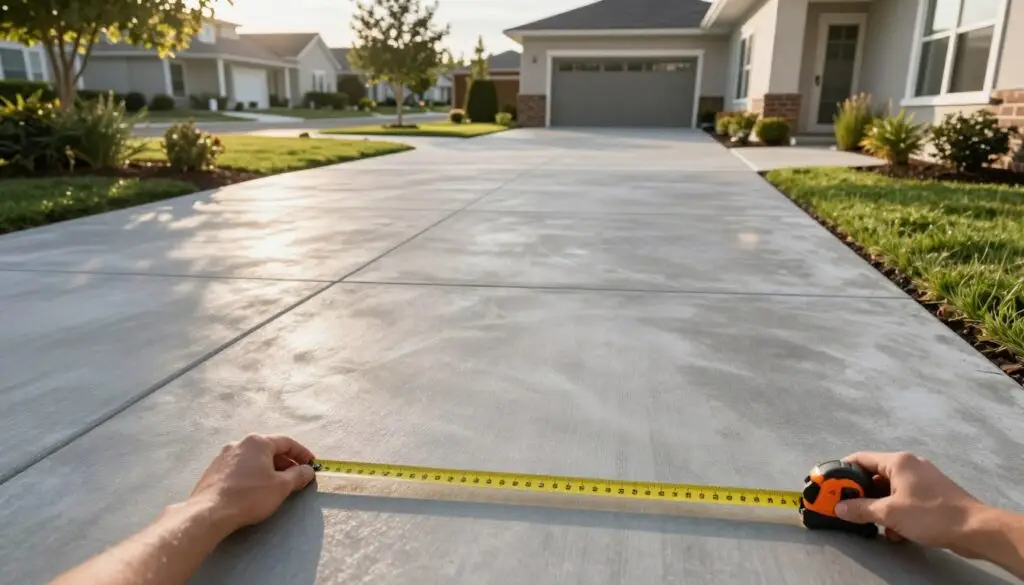
Build a Solid Base: Subgrade and Subbase Best Practices
A strong base starts beneath the slab and decides long-term performance. Proper subgrade work reduces settlement and limits visible cracking later. Anchored Construction & Restoration prepares uniform subgrades, installs well-graded aggregate bases, and manages site drainage before placement.
Compacted gravel thickness: 4-6 inches typical
Most driveways perform well with a compacted aggregate base of 4–6 inches. On weak or moisture-prone soil, plan for 8 inches or more to improve support.
Geotextiles and stabilization for clay or wet areas
Geotextile fabric reduces pumping and rutting over clay and saturated zones. It helps keep the base uniform and spreads tire loads evenly beneath the slab.
Drainage and grading to prevent settlement and cracking
Directing water away prevents base erosion and keeps the surface stable. Simple grading and installed drains stop moisture from undermining the subgrade.
- Stiff, uniform base: spreads loads and lowers bending in the slab.
- Right depth: 4–6 inches for normal soils; more on weak ground.
- Site verification: Anchored Construction & Restoration checks compaction and base thickness before any pour.
- Good drainage: preserves the base and reduces long-term maintenance.
Reinforcement That Works: Wire Mesh, Rebar, and Fibers
Reinforcement choices decide whether a slab stays quiet or shows hairline breaks over time.
Anchored Construction & Restoration selects reinforcement based on slab thickness, expected use, and joint layout to control cracking and improve performance.
Wire mesh for 4–5 inch slabs
Welded wire mesh suits many 4–5 inch sections. It holds hairline cracks tight when held up on chairs and placed near mid-depth.
Rebar grids for 5–6 inch and high-stress zones
For heavier loads, rebar grids (#3 or #4 at 12–18 inches on center) spread stress and add load capacity. Proper elevation matters; steel sitting on the subgrade helps little.
Fibers to reduce early shrinkage and boost toughness
Fibers cut plastic-shrinkage cracking in the first hours and days. They add toughness but do not replace joints or steel.
- Reinforcement keeps any cracks tight and shares stress across the panel.
- Wire mesh works well when supported at the correct elevation.
- Rebar grids suit thicker, high-stress areas for greater strength.
- Fibers help early cracking and at saw-cut edges.
Anchored Construction & Restoration places reinforcement on chairs and coordinates steel with joint layout for a strong, quiet slab that handles daily loads without visible widening of cracks.
Control Joints, Edge Thickening, and Aprons
A planned joint layout turns inevitable movement into clean, intentional lines.
Joint spacing and depth: Place control joints at a distance in feet equal to 2–3 times the slab thickness in inches. Cut joints to about one-quarter of the slab depth. This guides shrinkage into straight, neat cuts and limits random cracks.
Perimeter protection and edge thickening
Edges need extra strength where support is weakest. Thicken the slab by 1–2 inches and extend that deeper band 4–8 inches inward from the form. That detail reduces chip-outs and corner breaks under turning loads.
Aprons and code-driven sections
Many cities require 5–6 inches at the apron to handle repeated turning and utility vehicles. A thicker apron protects the street transition and improves long-term performance.
- Proper joints direct shrinkage into predictable lines.
- Plan joint lines to match garage jambs and walks for a clean pattern.
- Timely sawing prevents raveling as the slab cures.
- Anchored Construction & Restoration integrates joint and edge details with you before forms go up.
Cost, Concrete Volume, and Long-Term Value
A modest increase in slab depth can change both budget and performance for years.
Anchored Construction & Restoration explains where added depth delivers value. Increasing a 4-inch section to 5 inches raises load capacity by nearly 50% while adding about 20% to material costs. That trade-off often makes sense where vehicles turn or park daily.
Quick cost impact of one extra inch
One more inch usually means more yards of mix and a modest material bill increase. Expect extra labor for thicker edges and any rebar or mesh. Those items raise initial budget but cut repairs later.
Simple volume formula for budgeting
Use cubic yards = area (sq ft) × thickness (in) ÷ 324. For a 20×40 example: 4 in = 9.88 yd³; 5 in = 12.35 yd³; 6 in = 14.81 yd³. This quick check helps you preview the material line in your project estimate for a typical driveway slab.
Value over years
A slightly thicker section improves long-term durability. It resists heavy use, freeze-thaw stress, and edge damage. Less patching and fewer joint repairs save money across the years.
- One extra inch often gives big performance gains for modest added cost.
- Run the volume formula to see yardage and material needs before you commit.
- Anchored Construction & Restoration itemizes options so you choose the right balance for your project.
Knoxville & East Tennessee Guidance from Anchored Construction
Site visits reveal the small details that change a good slab into a long-lasting one for area homeowners.
Local know-how: soil, slopes, and freeze-thaw considerations
Anchored Construction & Restoration knows Knoxville soils and rolling slopes. The team studies soil conditions, runoff, and bearing capacity before recommending a plan.
In seasonal climates, an air-entrained exterior mix and correct jointing improve surface durability. Edges and aprons often benefit from deeper sections where vehicles turn.
Get a tailored driveway plan and quote
The company provides a clear, itemized project proposal. Plans cover slab thickness, base improvements, reinforcement, and joint layout matched to your footprint.
- Designs that fit slopes and runoff paths.
- Base recommendations for mixed soils in East Tennessee.
- Consideration for local apron standards and heavy vehicle passages.
Founded in 2000, Anchored Construction is led by Travis Bullington, a Knoxville native and University of Tennessee graduate. Call (865) 316-6933 or email Info@anchoredconstructiontn.com to schedule a visit and get a detailed quote.
Conclusion
A clear end plan ties thickness, base work, and reinforcement into a driveway that lasts. Match slab depth to vehicles, soil, and traffic for the best balance of strength and cost.
Anchored Construction & Restoration recommends a well-compacted base, proper jointing, and correctly placed reinforcement. Wire mesh suits thinner areas; rebar fits high-stress zones and aprons.
Thicker edges and code-compliant aprons protect turning areas and cut long-term cracking and surface damage. Use simple volume math to see where extra inches deliver value over years.
For a tailored plan and precise quote, call (865) 316-6933 or email Info@anchoredconstructiontn.com. Get the right thickness concrete driveway that performs for decades.