How much should you really plan to spend when planning a new industrial building in East Tennessee?
This buyer’s guide answers that question with clear, local insight. It explains what drives baseline figures, from material markets to labor and schedules. Readers get per square foot ranges and simple examples you can use today.
Anchored Construction has served Knoxville and East Tennessee since 2000 under Travis Bullington. The team blends local knowledge with practical skills in concrete, excavation, pallet racking, and site work.
The guide helps you set a realistic budget, compare options, and protect project timelines without sacrificing quality. It also shows how typical per square foot numbers add up for a 60,000-square foot facility and how local factors change estimates.
Key Takeaways
- Understand the main drivers behind modern costs and where to expect variability.
- See realistic per square foot ranges for dry, cold, and regional facilities.
- Learn which scopes — slab, racking, excavation — most affect schedule and budget.
- Find practical ways to control costs while keeping quality and durability.
- Get local contact details to move from planning to execution with a trusted team.
Warehouse construction cost snapshot for decision‑makers
Use these up-to-date per-square ranges to judge bids and sharpen your planning for local projects. Anchored Construction brings Knoxville bidding insight so you can compare quotes and prioritize the scopes that move budgets fastest.
Typical cost per square foot by project type
Standard dry: $20–$60 per square foot for shell, slab, lighting, sprinklers, and standard dock doors.
Regional distribution: ~ $214 per square foot on average, driven by higher clear heights and dock count.
Cold storage: $241–$344 per square foot because of insulation, vapor barriers, and refrigeration systems.
What changed recently: materials, labor, and market pipeline
Smaller projects averaged about $139 per square in early 2025, while medium and large projects dropped to $85 and $77 per square foot respectively. Scale matters: larger builds capture procurement and labor efficiencies.
- Annual increases have averaged 4–6% since 2020, with a ~15% bump since 2022.
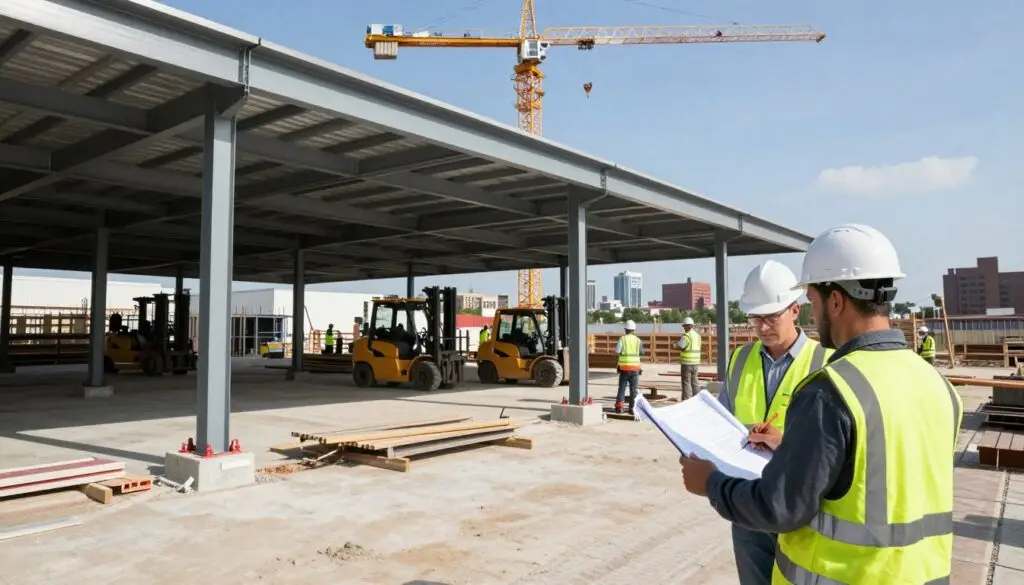
- Labor availability and steel lead times remain primary schedule risks.
- A softer national pipeline has eased some materials volatility, but suppliers still price in risk.
Practical next step: Call Anchored Construction at (865) 316-6933 or email Info@anchoredconstructiontn.com for a quick, local per-square allowance tailored to your site and planning window.
Understanding total warehouse construction costs
Start by breaking a total budget into predictable parts so you can see where money matters most. Anchored Construction guides clients through this process, aligning design with Knoxville permitting, utilities, and site realities.
Hard, soft, contingency, and land
Hard costs typically make up about 70% of the total. They cover slab, steel frame, envelope, and MEP systems for the building.
Soft costs run near 15% and include A/E fees, permits, legal and financing. These are unavoidable during planning and delivery.
Contingency is commonly 7–10% and reflects market volatility. Lenders often expect this to protect against price swings in steel and electrical gear.
Land sits outside per square foot construction figures and should be treated as a separate investment decision.
How inflation and procurement timing affect your budget
- Inflation since 2020 has averaged about 4–6% per year in many markets, which compounds across long schedules.
- Sequencing procurement helps. Lock priority packages when pricing dips and delay non‑critical scopes to later bids.
- Transparent tracking of allowances and alternates keeps the project flexible and the budget aligned with lender expectations.
Practical tip: Define must-have needs versus nice-to-haves early. That protects contingency and keeps the investment focused on true priorities.
Hard cost breakdown: slabs, steel framing, tilt‑up, docks, and systems
Decisions about slab thickness, steel framing, and dock layout set the pace for schedule and pricing.
Concrete slab thickness and heavy storage implications
Typical slabs in warehouse construction run 4–6 inches and average about $5–$7 per square foot. Increase to 6 inches when forklifts exceed 5 tons.
For very heavy storage above 40,000 pounds, expect roughly $0.75 per square foot for each extra 2 inches of slab. Anchored Construction & Restoration self-performs concrete and excavation work to match slab design to racking and equipment needs.
Pre‑engineered metal buildings vs. tilt‑up concrete
Pre‑engineered steel frames typically run $10–$20 per square foot. Tilt‑up concrete shells sit around $25–$40 per square foot.
Pre‑engineered often delivers the fastest shell and lower per square cost. Tilt‑up can be efficient on large footprints and adds long-term durability.
Fire suppression, lighting, loading docks, and finishes
Fire suppression ranges $1–$4 per square foot. Energy‑efficient LED lighting adds about $3.2–$4 per square foot. Floor finishes such as densifiers and joint treatments fall near $4–$7 per square foot.
- Loading dock packages typically cost $6,000–$11,000 each; hydraulics add about $1,000 per door.
- Anchored’s racking team coordinates dock heights, pit steel, and anchors to speed inspections and reduce rework.
- Plan sustainability and resilience allowances early; expect $2–$6 per square foot for compliance and $4–$10 per square foot for floodproofing where needed.
Soft costs most teams underestimate
Soft fees can quietly add up and reshape your whole project cost. Owners and managers who focus only on hard line items often find surprises at permit review or closeout.
Design and engineering typically run 4–6% of hard costs. Permits and impact fees vary by jurisdiction and often add 0.5–3% of total costs.
- Design: Align drawings to operations so you avoid paying for features you won’t build.
- Permits & insurance: Builder’s risk is roughly 1% and protects the job from weather and theft.
- Financing & schedule: Interest accrues daily; early procurement trims financing exposure.
- Commissioning & systems: Validate life‑safety and tech before turnover to cut rework.
- Environmental checks: Redeveloped sites can add 1–5% for assessments and mitigation.
Anchored Construction & Restoration helps owners anticipate these items and coordinate with lenders and reviewers. Treat soft costs as part of the baseline budget so your building and construction plan stays on track.
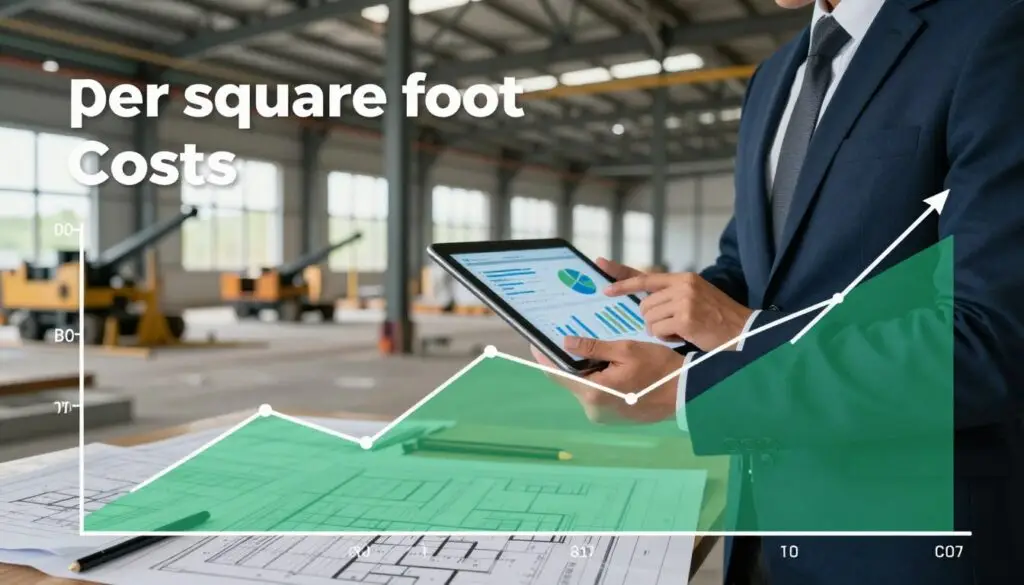
warehouse construction cost per square foot: small, medium, and large projects
Per‑square estimates shift a lot with project scale; understanding that shift helps you set realistic targets. Size affects mobilization, overhead, and how trades price their work.
Benchmark ranges and why size changes your psf
Early 2025 benchmarks: small projects averaged about $139 per square foot, medium projects ran near $85 per square, and large projects averaged roughly $77 per square foot.
Smaller buildings carry higher unit figures because mobilization, specialty trades, and fixed overhead spread over fewer feet. Medium footprints often hit a sweet spot where structure, MEP, and roofing buy competitively.
- Large facilities benefit from bulk buys and fewer perimeter conditions per square foot.
- Operational choices like higher clear heights and extra docks raise unit pricing but can improve throughput and ROI.
- Cold storage can be roughly 5–10x a dry facility per square foot due to insulation and refrigeration.
- Anchored’s teams translate these benchmarks into line items for Knoxville sites, modeling sitework, utilities, and slab volumes by size class.
Practical step: Use these ranges to set early targets, then refine with geotech, slab design, and utility service data so your design aligns with the right size class.
Regional cost drivers and what they mean for East Tennessee
Local rules, soils, and labor availability shape final bids more than national averages suggest. Anchored Construction & Restoration uses Knoxville experience to translate those signals into practical budgeting and risk control.
How codes, labor, and sitework shift your estimate
Building codes and inspection practices change requirements for fire suppression, envelope performance, and energy compliance. Those details affect the per square foot allowances you should budget.
Labor supply and crew productivity create wide bid spreads. Timing bids around regional workload often improves pricing and reduces schedule risk.
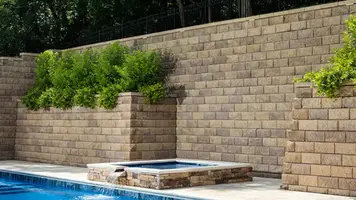
Sitework is a major swing factor in East Tennessee. Rock removal, stormwater controls, and retaining walls can push allowances up quickly. Anchored’s excavation and retaining wall capabilities help keep these items under control.
Nearby market signals: Memphis, Atlanta, and competitiveness
- Memphis and Atlanta show competitive unit pricing for medium and large footprints, which can inform Knoxville budgets.
- Transport distance for steel and major materials adds premiums; align procurement with nearby mills when possible.
- Early utility coordination reduces hold time and minimizes unexpected fees.
Climate resilience and building codes shaping modern warehouses
Preparing a building for wind, flood, snow, wildfire, and heat starts in early design and pays off over decades. Anchored Construction & Restoration aligns Knoxville building codes and insurer expectations to reduce long‑term risks.
Wind, flood, snow, wildfire, and extreme heat premiums
Enhanced wind resistance typically raises structural budgets by about 3–5%. Flood elevation or protection can add approximately $8–$15 per square foot.
Wildfire hardening often increases envelope expenses by 2–4%. Adding snow capacity costs roughly 2–3% of structural sums. Extreme heat measures may add $3–$7 per square foot.
Insurance and lender requirements tied to resilience
Missing resilience features can raise premiums 15–35% or limit coverage. Lenders now expect documented mitigation steps during permitting.
- Match resilience to site hazard profiles to control long‑term costs and protect your investment.
- Elevate critical equipment and size roofs for snow and future solar to avoid rework.
- Document assemblies and file clean submittals to speed underwriting and approvals.
Sustainability, insulation, and HVAC choices that impact lifetime cost
Early planning for renewables and efficient HVAC reduces monthly expenses and future retrofit needs. Anchored Construction & Restoration builds readiness into the design so owners avoid expensive rework later.
Envelope performance and insulation set HVAC size and energy use. Enhanced insulation typically adds about $1.50–$4 per square foot and can cut energy bills 20–30% annually.
LEED and incentives often add $2–$5 per square foot in fees and documentation. Those pathways frequently unlock tax credits, utility rebates, or faster permitting that improve the investment case.
Storm‑water and site systems
Low‑impact storm‑water systems run roughly $2–$8 per square foot for compliance. Early civil coordination prevents permit delays and redesign fees.
Renewables and electrification readiness planning
Plan roof reinforcement and pathways for EV charging during the base build. Reinforcement runs about $1–$3 per square foot. EV chargers cost $10,000–$50,000 each to install later, so readiness saves money.
- Lighting and controls: Efficient lighting and sensors cut operating expenses and often qualify for rebates.
- Rooftop solar readiness: Solar at $1.50–$2.00 per watt can reach a 6–8 year ROI when sized to operations.
- Battery & geothermal options: Battery storage is $800–$1,200/kWh; geothermal HVAC is $15–$30 per square foot with deep energy savings.
Anchored evaluates total cost of ownership. The goal is to align first costs with lifetime savings so your building delivers lower operating bills and stronger long‑term value.
Technology integration: WMS, automation, sensors, and smart building systems
Plan technology around actual throughput to protect ROI and avoid overbuild. Early decisions shape how smoothly systems fit the slab, conduits, and racking.
Upfront costs vs. 2–4 year payback potential
Baseline pricing: WMS runs about $0.50–$1 per square foot (or $20k–$50k). IoT sensors average $2–$7 per square foot. Automated handling ranges $25–$120 per square foot. Smart building systems fall near $5–$10 per square foot. Security and access control are $2–$5 per square foot.
- Embed power, conduit, and anchors in the slab during early design so equipment installs without rework.
- Many systems raise first cost but repay via labor and energy savings in 2–4 years, depending on throughput and labor rates.
- Match WMS, sensors, and automation to real distribution needs; oversizing erodes ROI.
- Right‑size server rooms and Wi‑Fi. Coordinate racking with conveyor and robot paths for better performance.
- Anchored Construction & Restoration coordinates slab embeds and MEP interfaces so future upgrades go faster and with fewer change orders.
Construction methods and process: from sitework to shell to interior
A clear, staged process keeps projects moving from rough grading to finished interiors without surprise delays.
Typical timeline phases are predictable. Concept planning runs 1–2 months. Design and permitting take 2–6 months. Sitework and utilities usually need 1–3 months.
The building shell then follows. Expect 4–8 months for the shell depending on steel lead times. Interior completion often requires another 2–6 months for equipment and systems integration.
Strategies to accelerate delivery
- Start geotech and utility applications early to compress permitting and mobilization.
- Use pre‑engineered metal systems and early slab pours to trim schedules by 6–10 weeks.
- Track steel framing lead times closely; mill slots set the critical path.
- Coordinate docks, pits, and racking anchors during shell erection to avoid rework.
- Align vendor lead times for equipment and systems with shell milestones to speed interior turnover.
Anchored Construction & Restoration self-performs excavation and concrete. That capability enables earlier sitework starts and faster handoffs to steel, MEP, and racking teams.
Proactive inspections, batch submittals, and a clear phase plan reduce carrying exposure. Maintain modest schedule contingency for weather and inspections. Finishing faster often saves more than the premium to accelerate.
Sample budget model: translating unit costs into a 60,000‑sf facility
Below is a practical 60,000‑square foot model that shows how unit figures roll up to a project total. Anchored Construction & Restoration prepares Knoxville‑ready budgets that combine slab, shell, systems, and resilience into a single view.
From hard costs to contingency: what the totals look like
Line‑item example: slab 60,000 × $6 = $360,000; metal building 60,000 × $18 = $1,080,000; fire protection 60,000 × $2 = $120,000.
Lighting 60,000 × $3.5 = $210,000. Docks (12 × ($9,000 leveler + $1,000 door)) = $120,000. Sustainability 60,000 × $5 = $300,000.
Technology 60,000 × $8 = $480,000. Resilience 60,000 × $5 = $300,000. Hard subtotal = $2,970,000.
- Soft fees (15%): $445,500. Contingency (8%): $237,600.
- Approximate total: ≈ $3,653,100 (land excluded).
- Adjust line items for higher clear heights, added docks, or specialty HVAC and equipment to see how totals shift.
- Sequence steel, lighting, and technology procurement to protect pricing and financing exposure.
Use this model as a baseline to judge feasibility, structure financing, and create clear alternates for competitive bids. Anchored helps refine these numbers for site, utility, and permitting realities in East Tennessee.
How to reduce warehouse construction costs without sacrificing quality
Smart early decisions trim long‑term expenses while keeping a building durable and functional. Anchored Construction & Restoration focuses on simple, durable details and scheduling that cut rework. The goal is lower lifetime outlay and preserved quality.
Design simplification, vertical optimization, and material price locks
Simplify geometry and finishes to reduce labor hours and long‑term maintenance. Pre‑engineered metal frames can save up to 30% on structural budgets while speeding schedules.
- Increase clear height to boost storage density and lower cost per pallet position.
- Cluster docks and right‑size aprons to cut paving and sitework quantities.
- Lock pricing for steel and major materials when markets soften; align delivery windows with schedules.
Phased automation and incentive stacking
Pre‑install conduits, embeds, and roof readiness so future systems and equipment add with minimal rework. Phase automation—add conveyors or AMRs when throughput justifies the spend.
- Stack incentives for lighting, HVAC, and renewables to reduce first outlay and shorten payback.
- Choose standard systems and components to keep lead times short and bids competitive.
- Anchored’s field coordination minimizes rework at docks, racking anchors, and MEP routing.
Knoxville buyer’s guide: plan, budget, finance, and build with Anchored Construction
Anchored Construction helps Knoxville owners turn site questions into a clear plan and a realistic budget. The team pairs local knowledge with hands-on services to keep the process efficient and predictable.
Local site conditions, permits, and scheduling in East Tennessee
Plan with Knoxville building codes and inspectors in mind. Early meetings save weeks and lower change orders.
Budget for geotech, drainage, and rock removal first. Those items often drive final bids more than finishes.
Coordinate utility service applications early. Power and water timelines frequently set start dates.
Anchored services that control costs: concrete, excavation, racking, and repairs
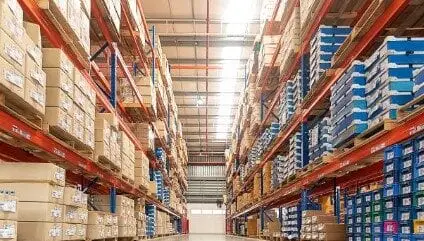
Anchored self-performs concrete and excavation, giving owners tighter control over schedule and quality. They also install pallet racking and handle dock packages.
Repair and maintenance programs protect the facility after turnover. That preserves uptime and long-term value.
- Concrete services and bobcat excavation
- Racking, dock coordination, and retaining wall repair
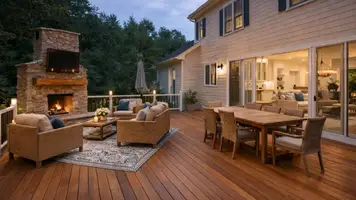
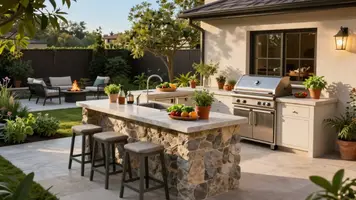
- Decks, landscape, and outdoor kitchen builds for site amenities
Start your estimate: Anchored Construction | (865) 316-6933 | Info@anchoredconstructiontn.com
Finance with a realistic schedule. Align draws with major material releases and inspections to limit interest.
Use a single point of contact at Anchored to keep design, procurement, and field activities synchronized. Schedule a site walk to get a tailored budget and clear scopes.
- Plan with codes and inspectors early
- Budget site conditions first—geotech and drainage matter
- Coordinate utilities and define alternates for sharper bids
Conclusion
Wrap up your plan with clear benchmarks and local insight. Use the $20–$60 per square foot baseline for basic dry builds. Expect sustainability, resilience, and technology to add roughly 15–30% to that figure.
Successful projects start by mapping hard and soft fees, contingency, and land into a single budget. Prioritize the big drivers: structure, slab, MEP, docks, and envelope. Sequence procurement to manage steel and equipment markets.
Align racking and power with the slab to avoid rework. Add resilience and efficiency early to lower lifetime expenses and satisfy insurers.
Anchored Construction & Restoration stands ready to guide Knoxville owners from first estimates to ribbon cutting. Call (865) 316-6933 or email Info@anchoredconstructiontn.com to start your estimate.