How much should you really expect to pay for a new retaining wall on your Knoxville property?
Anchored Construction & Restoration has served East Tennessee since 2000. After 25+ years, their team led by Knoxville native Travis Bullington helps homeowners plan, design, and build walls that perform and look great.
Start with a practical benchmark: the national average cost to install a retaining wall is about $6,300, with most projects between $3,500 and $9,400. Local site conditions and material choice change that number more than any single factor.
Complete installation includes design, excavation, base prep, drainage behind the wall, waterproofing, and finish work. Proper planning prevents failures and saves money over time.
Call (865) 316-6933 or email Info@anchoredconstructiontn.com to discuss your property, project scope, and realistic price ranges. Anchored Construction can manage the entire build from concept through excavation and installation.
Key Takeaways
- Use the national average as a starting point but expect local variation.
- Soil, drainage, and site prep often drive final pricing more than materials.
- A full build covers design, excavation, drainage, and finish work.
- Professional installation improves durability and warranty value.
- Anchored Construction offers local expertise and end-to-end project management.
Knoxville retaining wall cost overview for homeowners and businesses
Local terrain and soil in East Tennessee make standard national figures just a starting point.
National averages show most projects between $3,500 and $9,400, with a $6,300 average and pro rates near $20–$53 per square foot. In Knoxville, heavy rainfall, clay pockets, and steep lots often demand stronger drainage and reinforcement. That drives differences in final estimates.
Two similar-looking walls can vary widely in price due to height, surcharge loads, and required engineering. Commercial projects usually call for heavier structural solutions than small residential garden projects. Labor, material availability, permits, and site access on tight or sloped properties also affect bids.
- Anchored Construction evaluates soils, slopes, utilities, and existing drainage on-site.
- They explain per-square-foot vs. per-linear-foot pricing and recommend the best model for your property.
- Early planning speeds permits, design choices, and construction timelines while reducing long-term maintenance.
For a local estimate tailored to East Tennessee, call (865) 316-6933 or email Info@anchoredconstructiontn.com.
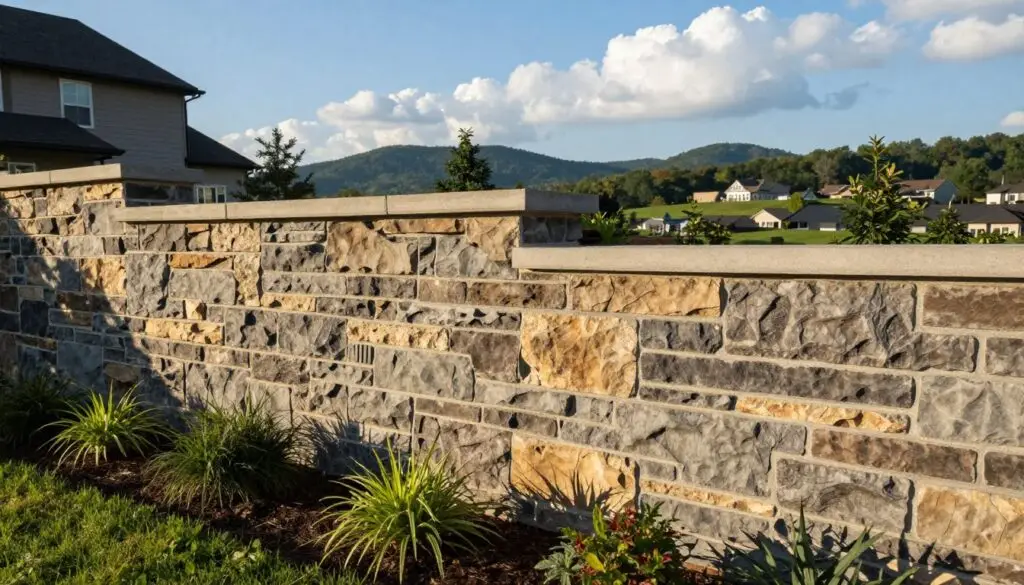
Retaining wall cost: average cost ranges and what they include
Understanding common price ranges clears confusion when comparing contractor proposals.
Typical price per square foot for professional installation runs about $20 to $53, with an average near $33 per square foot. Some projects price by linear measures instead. For example, driveways often land between $38 and $138 per linear foot. Slope or shoreline runs can range $40 to $200 per linear.
What a complete estimate should show
- Materials: blocks, poured concrete, rebar (about $1.50–$2.50 per sq ft), caps, and finishes.
- Site work: excavation, grading, base aggregate, hauling and disposal fees.
- Drainage and waterproofing: fabric, pipe, French drains, and waterproofing ($2–$10 per sq ft).
- Reinforcement and engineering when heights or surcharge loads require it.
Anchored Construction provides transparent proposals that list labor, materials, drainage components, excavation, and finishes. Homeowners should compare line-by-line to confirm proper drainage, geogrid or geotextile allowances, and professional compaction are included.
Cost estimator by size: height, length, and square footage
A reliable budget starts with simple measurements: feet of length and feet of height. Anchored Construction measures these dimensions and checks site loads to create a property-specific estimate.
How to calculate square footage: Multiply wall height by wall length. That number drives the base price per square foot. For reference, most installs run about $20–$53 per square foot.
Per linear foot vs. per square foot explained
Some projects price per linear foot when location or placement matters. Driveway edges, shorelines, and stepped runs often use per linear pricing because access and surcharge loads change labor and materials.
- Square-foot model: height × length = total sq. ft. Multiply by the chosen rate.
- Linear-foot model: used for placement-driven builds where each foot needs unique base or reinforcement.
- Anchored Construction will convert estimates between models so you can compare apples to apples.
How height and soil pressure change design
As height increases, soil pressure rises and design shifts from simple gravity systems to reinforced solutions. Taller structures often need deeper bases, longer geogrid, and engineered plans.
- Geogrid length scales with height and soil type, changing materials and labor.
- Step-ups on slopes increase total square footage and block counts.
- Proper drainage behind the structure becomes more critical as height grows.
Example ranges: 42 sq. ft. ≈ $840–$2,226; 175 sq. ft. ≈ $3,500–$9,275; 350 sq. ft. ≈ $7,000–$18,550. For a precise on-site assessment, call (865) 316-6933.
Retaining wall prices by material in Knoxville
Choosing the right material for a Knoxville property shapes performance, appearance, and long-term value. Anchored Construction builds with interlocking blocks, poured concrete, precast panels, natural stone, timber, and gabion systems.
Concrete blocks and interlocking systems
Interlocking concrete blocks offer speed and engineered strength for many yards. Typical material ranges run $15–$35 per sq ft. Cinder and landscape blocks fall between $15–$60 per sq ft depending on finish.
Poured concrete and precast options
Poured concrete and precast panels suit long spans and curved designs. Expect $20–$40 per sq ft. Poured concrete can last up to 100 years with proper drainage.
Stone, wood, gabion, vinyl, and steel
- Natural stone and boulders: $20–$90 per sq ft; 40–100 years.
- Wood/timber: $13–$35 per sq ft; 20–40 years with maintenance.
- Gabion baskets: $10–$40 per sq ft for fast installs and good drainage.
- Vinyl and steel: thin profiles for tight sites; steel ranges higher ($42–$150 per sq ft).
Note: Caps, steps, and seating add finishes. Proper drainage matters for every build to avoid pressure and movement. Anchored Construction recommends an on-site review to match your design and budget with the best-performing material.
Cost by wall type: gravity, anchored, cantilever, segmental, sheet piling
Site forces, access, and desired height determine the best structural type. Anchored Construction & Restoration evaluates load, space, and local code before recommending a solution.
Typical ranges per square foot: Gravity $10–$30; Anchored $10–$30; Cantilever $20–$25; Counterfort $15–$25; Segmental $15–$35; Sheet piling $10–$50.
- Gravity: heavy mass works for low heights and light surcharge. Simple base prep and good drainage suffice.
- Anchored/tie-back: cables or helical anchors support taller or loaded structures. They change excavation depth and reinforcement needs.
- Segmental systems: modular blocks that can act as gravity or be reinforced with geogrid. Versatile and faster to install.
- Cantilever/counterfort: steel-reinforced concrete with larger foundations for significant heights and loads.
- Sheet piling: ideal for narrow zones and waterfronts where excavation space is limited.
Each type affects reinforcement, concrete quantity, foundation depth, and long-term maintenance. Proper drainage lowers problems over time. For a clear recommendation and on-site estimate, call Anchored Construction & Restoration to review loads, soil, and space constraints.
Placement matters: driveway, backyard, pool, slope, shoreline
Where a structure sits on your property drives design, permits, and pricing. Location sets the forces the team must resist and the access for equipment. Anchored Construction accounts for vehicle loads, pool adjacency, and steep Knoxville slopes when preparing an estimate.
Typical cost per linear foot by location
Per linear foot pricing varies by use and access. Typical ranges:
- Driveway: $38–$138 per linear foot — extra reinforcement for vehicle surcharge.
- Backyard / Front yard: $33–$255 and $30–$200 respectively — depends on grade and landscaping.
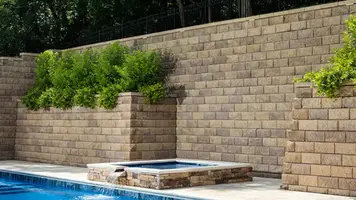
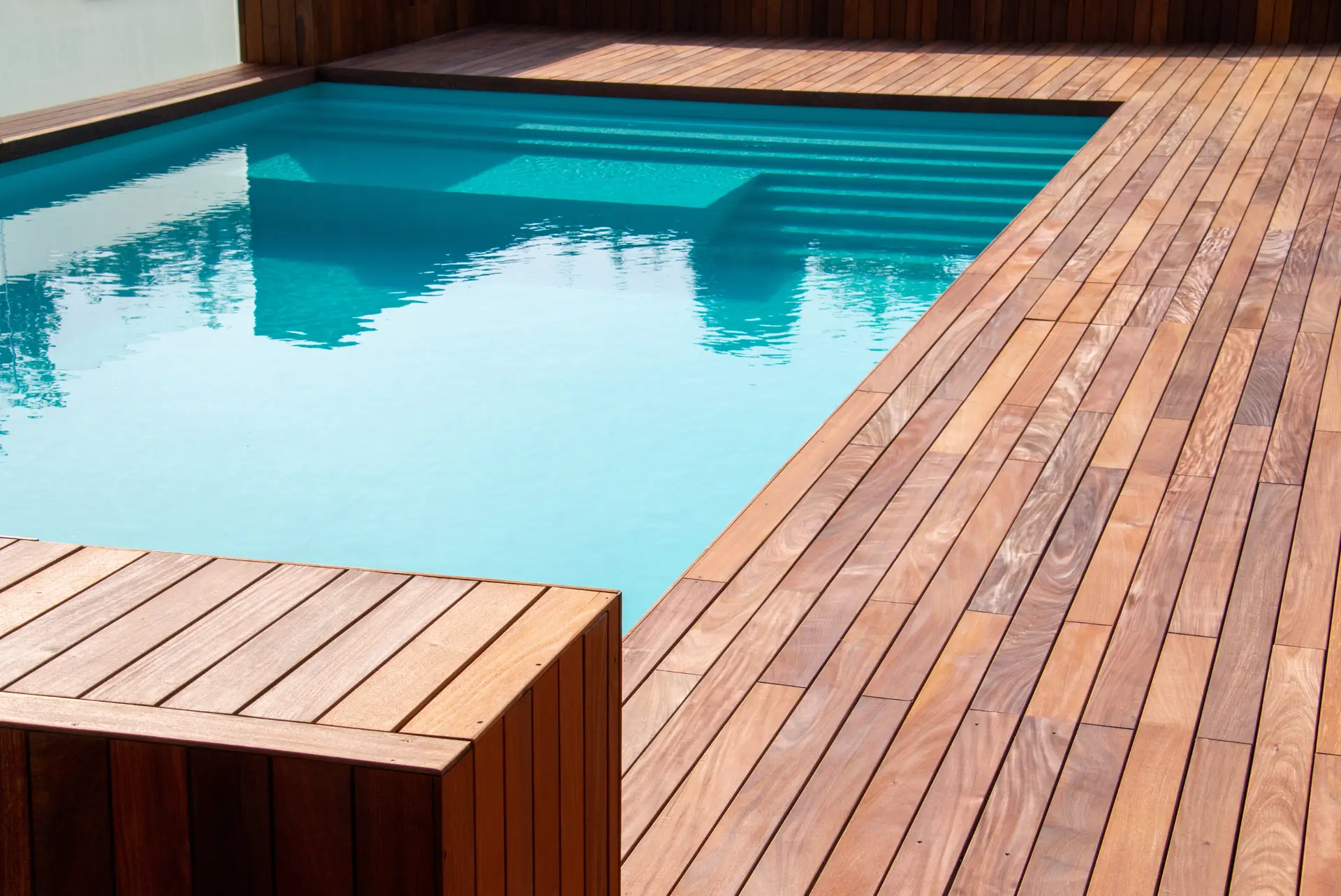
- Pool: $20–$100 per linear foot — waterproofing and select backfill are critical.
- Shoreline: $108–$288 per linear foot — limited access and coastal engineering add expense.
- Slope / Landscape: $40–$200 and $30–$150 per linear — steeper sites need regrading and geogrid.
Knoxville slopes and drainage considerations
Knoxville’s rolling terrain often increases excavation and drainage work. Steeper soil angles demand longer geogrid, deeper bases, and more robust drainage. Good drainage behind the structure reduces hydrostatic pressure and extends service life.
- Placement affects force, access, and permits — that shifts the budget.
- Pool-adjacent builds need waterproofing and careful backfill selection.
- Shoreline projects usually require specialized engineering and staging.
- Confirm utilities and setbacks with a site visit before final design.
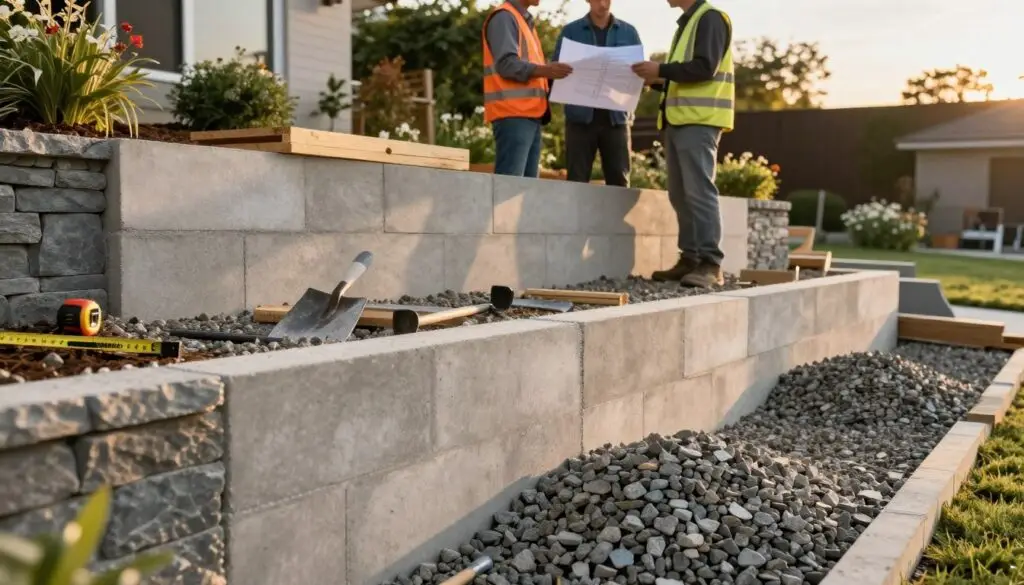
Site preparation and excavation: grading, clearing, and base preparation
Proper site prep sets the stage for a durable outdoor structure. It starts with a site walk to find tree roots, utilities, and access routes. Subgrade evaluation identifies soft spots and organics that must be removed before work begins.
Anchored Construction & Restoration provides in‑house bobcat and excavation services. That control helps manage labor and limits unexpected delays. Typical prep ranges include leveling at $0.40–$2.00 per sq. ft. and excavation at $50–$200 per cubic yard.
Bobcat and excavation services that affect price
- Haul‑off and staging affect labor and schedule.
- Site access determines equipment choice and time on site.
- In‑house excavation streamlines scheduling and workmanship control.
Foundation depth, frost line, and compaction
Knoxville frost depth guides embedment and base thickness. Proper base prep uses geo‑fabric, base stone, screeding, and plate compaction in lifts. Accurate elevations with laser leveling and planned drainage slopes reduce settlement over time.
- Excavation and subgrade cleanup.
- Geo‑fabric and base materials placement.
- Screeding and compaction to design elevation.
Good base work lowers long‑term maintenance for walls and ties into landscaping plans. Early site walks and clear communication about materials, concrete, and foundation needs keep projects on track and manage final costs.
Drainage and waterproofing: behind wall requirements that impact cost
Proper water control behind a structure is the single best way to prevent failures and extend service life. Anchored Construction designs drainage for East Tennessee rainfall using clean backfill, fabric, and controlled outlets to protect your investment.
French drains, weep holes, and backfill materials
Clean stone backfill, perforated drainpipe, and filter fabric form the core of a reliable drainage system. French drain installations can range from $1,650 to $12,250 depending on length and complexity.
Weep holes and daylighted outlets move water off the slope and reduce hydrostatic load. Waterproofing membranes add another layer and typically run $2–$10 per square foot.
Preventing soil erosion and hydrostatic pressure failures
Trapped water raises hydrostatic pressure and causes bulging, leaning, or cracking. Knoxville’s heavy rains make robust management non‑negotiable.
- Place outlets where flow can daylight or connect to storm drains; account for freeze cycles.
- Select free‑draining soil and keep outlets clear to avoid erosion and backups.
- Regular maintenance lowers future repair bills and extends service life.
Anchored Construction can include integrated French drain solutions as part of the project to ensure long‑term performance and reduce unexpected repair cost.
Reinforcements and engineering: rebar, geogrid, and tiebacks
Engineering choices determine how a high slope project resists soil pressure and stays stable. Anchored Construction & Restoration coordinates stamped designs for tall or loaded builds. That keeps work safe and code compliant.
When an engineer is required
Many local codes require a plan for walls over four feet or when supporting driveways, pools, or buildings. An engineered design protects your property and lowers long‑term risk.
Key reinforcement factors
- Steel rebar: used in poured concrete and filled block cores. Typical installation runs $1.50–$2.50 per sq ft.
- Geogrid design: layer spacing, embedment length, and soil friction are specified to meet safety factors.
- Tiebacks: anchored systems add lateral resistance where space is limited or heights exceed gravity limits.
- Foundations: footing depth and embedment size tie directly to height and soil type.
- Construction QA: compaction testing, grid tension checks, and alignment inspections ensure performance.
Reinforcement choices influence long‑term performance and influence cost. Anchored Construction can provide stamped drawings and handle permit submittals as part of a turnkey service.
Labor vs. DIY: cost per foot, tools, and risk
Deciding whether to DIY or hire pros starts with an honest look at time, tools, and risk. Small, low garden projects under 3 feet can work for experienced homeowners. Larger, loaded, or curved builds need professional labor and engineering.
DIY basics and typical totals:
- DIY ranges: about $4–$20 per sq. ft. for small, sub‑3‑foot projects.
- Block prices: cinder $1–$5 each; interlocking $2–$10 each.
- Tool kit: levels, shovels, tampers, saw rentals — roughly $157 for basic gear.
Why professional installation often wins:
- Pros average $20–$53 per sq. ft. and include drainage, waterproofing, and compaction.
- Licensed crews offer warranties and insurance for liability.
- Hidden risks: poor compaction, inadequate drainage, or an uneven base can cause movement and expensive repairs.
Anchored Construction & Restoration can review DIY plans, recommend a hybrid approach, or provide a free estimate so homeowners compare true landed costs before buying materials.
Permits, codes, and inspections in the Knoxville area
Local permitting rules can add steps to your project but protect safety and neighboring properties. Anchored Construction guides homeowners through these reviews to keep schedules on track.
Permit thresholds and engineering
Most jurisdictions require a permit for any retaining wall over 4 feet in height. Some sites need permits at lower heights when vehicle loads, driveways, or structures sit above the footing.
Setbacks, property lines, and plan review
Location near a property line, driveway, or public right-of-way may prompt extra reviews. Cities often require scaled plans showing foundation depths and finish grades.
Utility locates and excavation safety
Before digging, utility locates are mandatory. Marked lines influence excavation depths and where anchors or geogrid can be placed.
Inspection stages and documentation
- Initial permit submission and fee (typically $40–$450).
- Footing and base inspections before concrete or block placement.
- Mid-build checks for drainage, pipe placement, and anchors.
- Final inspection and as-built documentation for approval.
Drainage plans and discharge points receive scrutiny to protect neighbors from runoff and erosion. HOA or architectural reviews may add another approval step.
Anchored Construction handles paperwork, coordinates locates, and schedules inspections. Early engagement reduces permit delays and helps estimate realistic start dates for landscaping and other trades.
Project timelines: how long different retaining walls typically take
Project timelines vary widely, from quick garden installs to multi‑week engineered builds. Small garden walls often finish in a few days. Crews mobilize, prep the base, place block, add drainage, backfill, and clean up.
Mid‑height, engineered walls usually take one to several weeks. Permits and engineering add lead time before field work begins. Concrete cure times also affect schedules; poured footings and bases may need 3–7 days to reach set strength.
Typical sequential steps:
- Mobilization and site protection.
- Excavation and base preparation.
- First course placement and alignment.
- Drainage, backfill, and reinforcement.
- Finish work and final cleanup.
Weather and ground moisture influence excavation and compaction. Special‑order caps, stone veneer, or rare materials add lead time for materials. Anchored Construction updates schedules proactively when conditions or inspections change.
Teams maintain daily cleanup and site safety. Phased approaches keep driveways and access open on multi‑wall properties. Efficiency never compromises quality or required inspections.
Lifespan, maintenance, and long-term value
Durable construction turns a simple landscape feature into lasting curb appeal and practical space. Anchored Construction & Restoration builds for longevity and low upkeep so homeowners protect slopes and boost usable yard area.
Typical years of service by material and build type
Average service life varies by materials and design. Poured concrete can last up to 100 years. Natural stone generally lasts 40–100 years. Vinyl often reaches about 50 years. Gabion systems range from 10–75 years, while timber typically needs replacement after 20–40 years in wet conditions.
Maintenance and value
Simple upkeep keeps a structure functioning longer. Clear outlets, manage surface water, and inspect caps and joints after storms. High‑quality base prep, geogrid, and waterproofing extend usable years.
- Compare life expectancy by materials and reinforcement.
- Periodic checks after major weather events catch issues early.
- Durable finishes and cap units lower long‑term touch‑ups.
- Upgrades like seating, lighting, or terraces increase usability and curb appeal.
Return on investment: Well‑designed walls can add up to 15% to home value by creating usable terraces, reducing erosion, and enhancing curb appeal. Regular care protects that value and the surrounding landscape.
Related outdoor projects that pair well with retaining walls
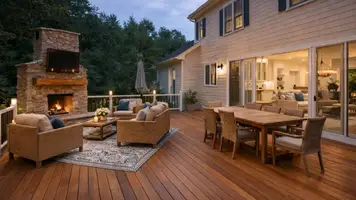
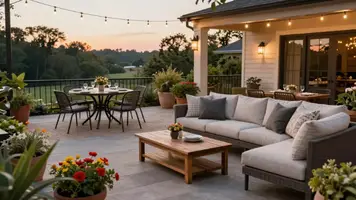
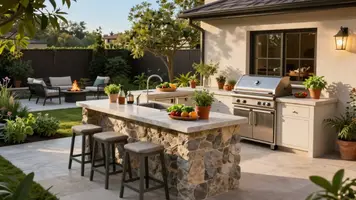
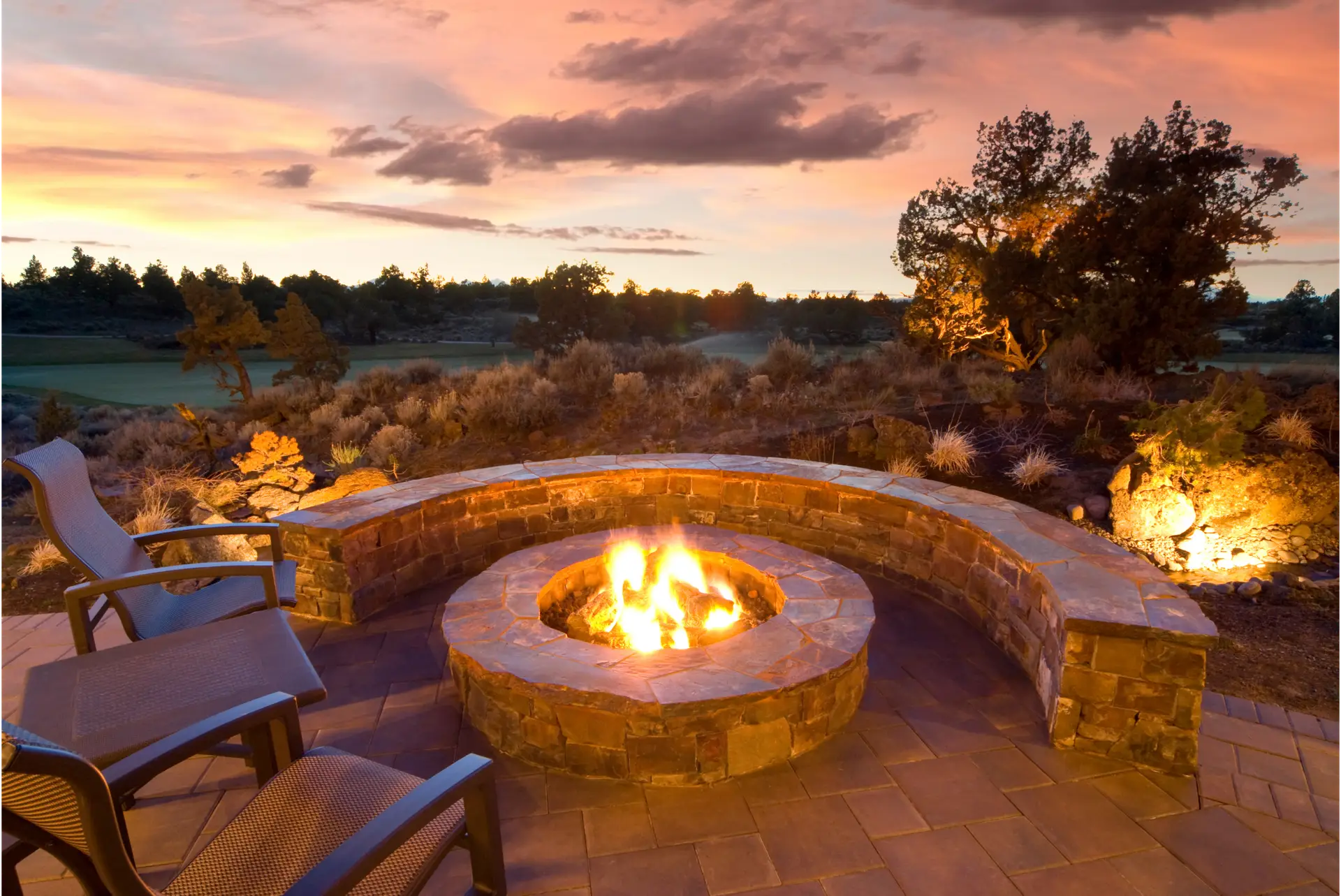
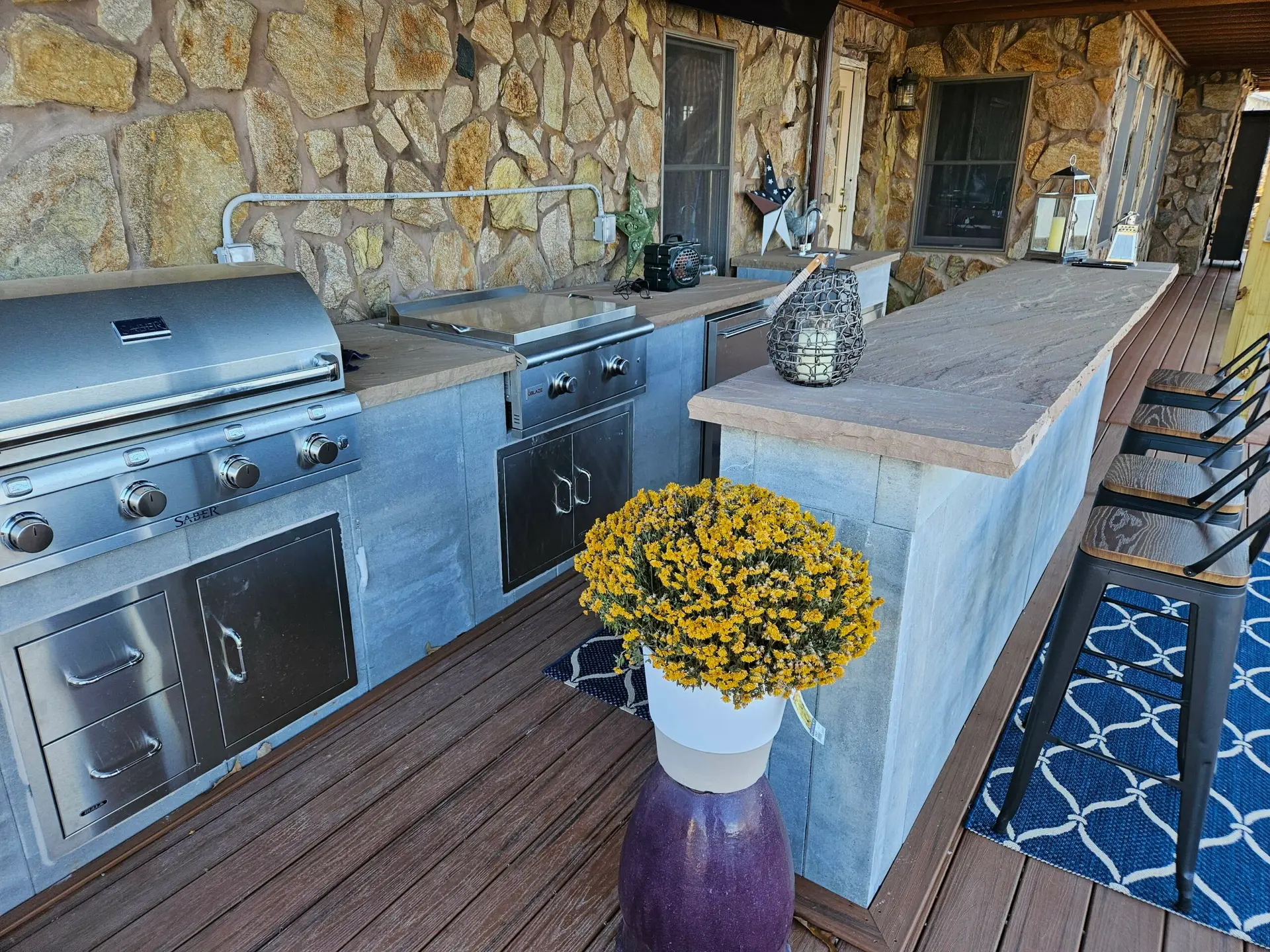
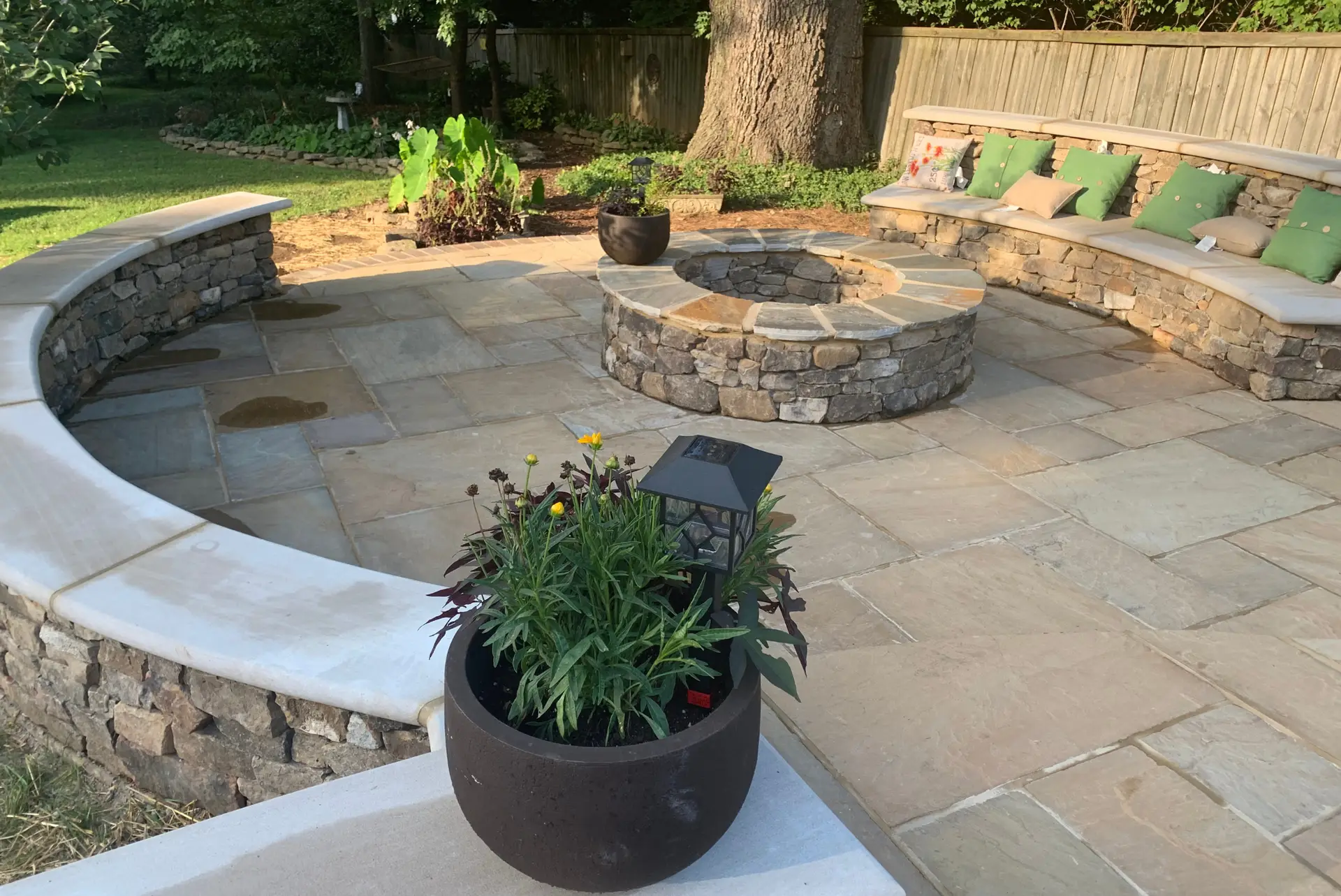
After a structural project, homeowners often want coordinated patios, plantings, and usable outdoor spaces. Anchored Construction offers landscaping, hardscape installation, and outdoor kitchen design to complete that vision.
Landscape and hardscape pairings:
- New terraces and stable slopes create room for patios, paths, and outdoor kitchens.
- Planting plans match materials and colors to block and stone finishes for a cohesive look.
- Steps, lighting, and seating integrate directly into segmental block or stone designs.
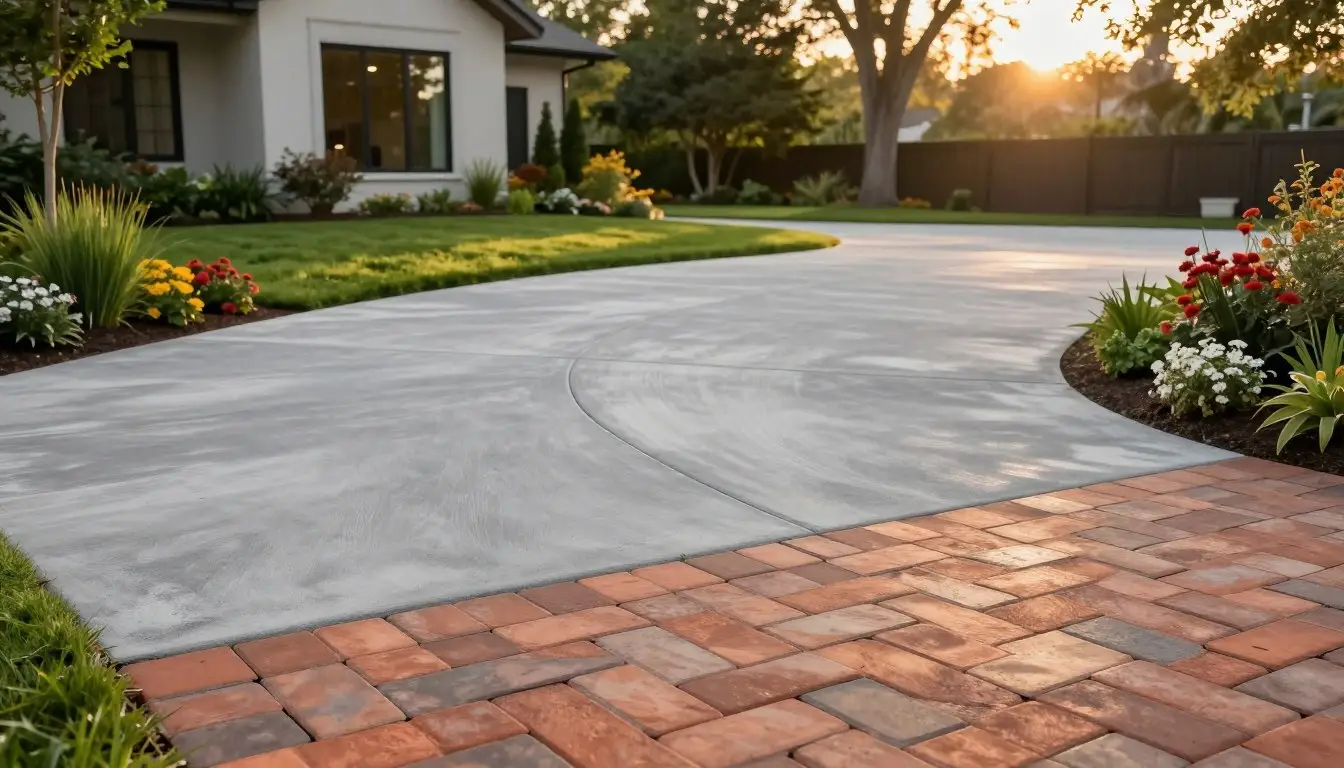
- Deck building and concrete flatwork tie levels together and improve circulation.
Decks, concrete services, and sod restoration
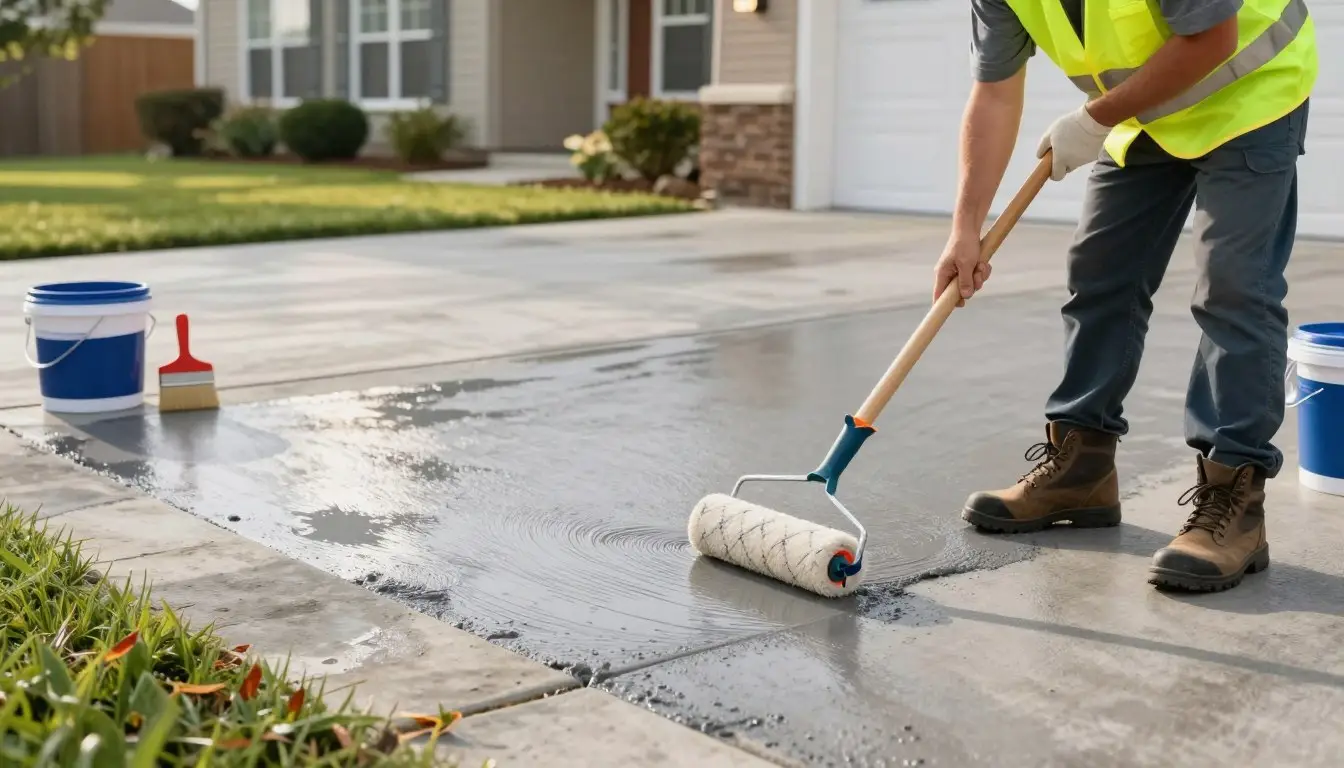
Anchored Construction handles deck framing, concrete pours, and sod restoration after grading. Sod installation typically runs about $0.87–$1.76 per sq. ft., depending on grass type.
Drainage and phased planning
French drains often pair with these projects and range from $1,650–$12,250 depending on scope. Plan irrigation and drainage to protect new plantings and finished surfaces.
- Use matching caps and pavers to unify hardscape elements.
- Schedule work to reduce disruption and optimize equipment use.
- Benefit from single-source accountability for design, build, and aftercare.
Why choose Anchored Construction for your Knoxville retaining walls
Anchored Construction & Restoration combines local knowledge with hands‑on experience. Founded in 2000 and led by Knoxville native Travis Bullington, the team focuses on practical solutions for homeowners and businesses.
25+ years of local experience
Proven track record: Over two decades solving slope and drainage issues across East Tennessee. The team understands clay soils and heavy rain patterns that affect long‑term performance.
Full-service delivery from design to repair
Complete support: Design, permitting help, excavation, drainage, installation, and repair. In‑house bobcat and excavation services streamline schedules and quality control.
Skilled crews, clear estimates, and durable results
- Expertise with concrete, interlocking block, stone, timber, and gabion systems.
- Precise site preparation and compaction standards that reduce movement and erosion.
- Transparent estimates with warranties, inclusive line items, and a realistic schedule.
- Insured crews, strong communication, and a final walkthrough to confirm satisfaction.
Professional installation usually yields better durability and erosion protection than quick fixes. Local knowledge of soils and drainage reduces failure risk and long‑term repairs.
For a no‑pressure consultation, call (865) 316-6933 or email Info@anchoredconstructiontn.com to review options for your home or property.
Conclusion
A well-planned end to your project ties budget, design, and long-term performance together.
Expect most professionally built retaining walls to fall near the national average of $3,500–$9,400 and about $20–$53 per square foot. Knoxville sites often need stronger drainage and, for taller structures, engineered plans.
Key drivers are size, material, wall type, placement, site prep, drainage, and reinforcement. Proper compaction and drainage are critical to performance and longevity. Engineered solutions are necessary as heights and loads increase.
Anchored Construction & Restoration offers transparent proposals, clear timelines, and options that balance durability and appearance. Call (865) 316-6933 or email Info@anchoredconstructiontn.com for a Knoxville-specific estimate and schedule.
Thank you for considering a professional approach that protects your property and budget.